Everyone's talking about AI in .NET.
Here's the exact path to use it.
From AI-curious to shipping real AI in 8 steps. Use AI to write .NET faster, then build AI features into your own apps - with runnable projects, not theory.
Send me the FREE AI Roadmap
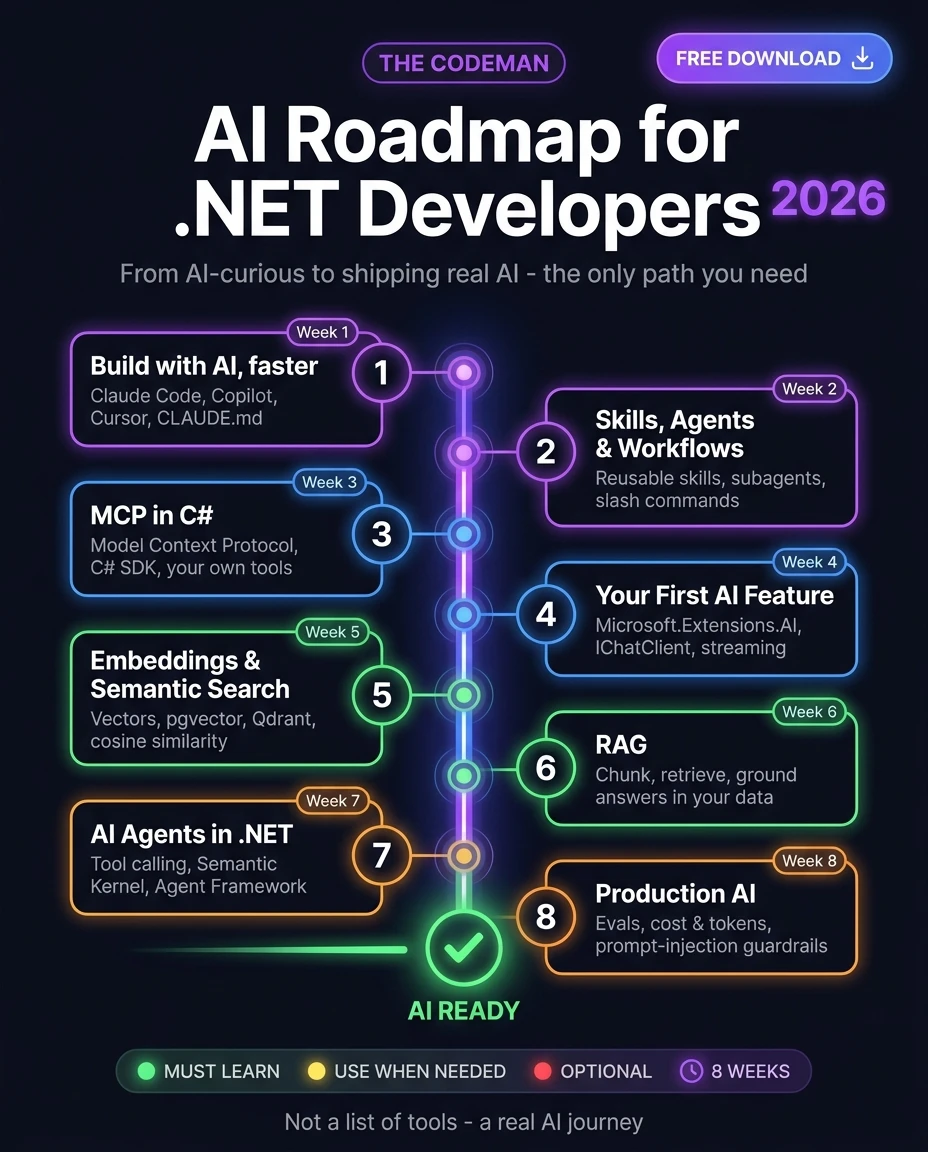
Each step builds on the last
Don't skip ahead - the order is the point.
AI Coding Assistants
Claude Code, Copilot, Cursor + the CLAUDE.md context file. Get faster today.
Skills, Agents & Workflows
Reusable skills, subagents, slash commands - make the AI a .NET specialist.
MCP in C#
Model Context Protocol - connect AI to your own tools and build a server in C#.
Your First AI Feature
LLMs with Microsoft.Extensions.AI & IChatClient - streaming, structured output.
Embeddings & Semantic Search
Vectors, pgvector / Qdrant, cosine similarity - search by meaning.
RAG
Chunk, retrieve, and ground the LLM in your data. The most in-demand AI skill.
AI Agents in .NET
Tool calling, Semantic Kernel / Agent Framework - reasoning plus action.
Production AI
Evals, cost & tokens, prompt-injection guardrails, observability.
Real code, real projects, a real plan
✓ The Full Roadmap Guide
8 progressive steps from your first AI-assisted commit to production AI features, with MUST vs OPTIONAL for every topic and two clear tracks: use AI, and build AI.
✓ 4 Portfolio Projects
Semantic Search, Document Q&A (RAG), an MCP server in C#, and a focused AI agent - three of them ship as runnable projects you can build from.
✓ 8-Week Learning Plan
A structured weekly plan so you always know what to build next. Two months, eight things shipped.
✓ Runnable .NET Projects
Working Semantic Search, RAG, and MCP server solutions in modern .NET 10 - clone, run, and extend.
✓ Free Claude Code Skills
Skills that make Claude write production-grade .NET instead of generic C# - install and use as you follow the roadmap.
✓ What NOT to Learn
Skip the hype. Know which AI topics to ignore (fine-tuning, transformer math, framework-of-the-week) so you save months.
The tools, introduced when you need them
Who is this for?
✓.NET developers who keep hearing about AI but don’t know where it fits in real work
✓Backend engineers who want to build AI features into their own apps
✓Developers who want to use AI coding tools well, not just install them
✓Teams leveling up on applied AI without the hype
What is this exactly?
A practical, opinionated roadmap for .NET developers who want to actually use AI - both to build faster (Claude Code, skills, MCP) and to build AI features into their apps (LLMs, embeddings, RAG, agents). It comes with runnable .NET projects, free Claude Code skills, an 8-week plan, and honest advice on what to learn and what to skip.
Frequently asked questions
What is the best AI roadmap for .NET developers in 2026?
The AI Roadmap for .NET Developers is an 8-step, 8-week guide that takes you from using AI coding assistants (Claude Code, Copilot, Cursor) to building AI features into your own apps - MCP servers in C#, LLM calls with Microsoft.Extensions.AI, embeddings, RAG, and AI agents. It classifies every topic as MUST or OPTIONAL and ships with runnable .NET projects.
How do .NET developers use AI in their work?
Two ways. First, use AI to write .NET faster: an assistant like Claude Code plus a CLAUDE.md context file, reusable skills, and agents. Second, build AI into your apps: call LLMs with Microsoft.Extensions.AI, add semantic search with embeddings, ground answers in your data with RAG, and build agents that call your C# tools via MCP.
What is MCP (Model Context Protocol) in .NET?
MCP is a standard way for AI clients (Claude, Copilot, Cursor) to call external tools and data. In .NET you build an MCP server in C# with the official ModelContextProtocol SDK, expose your operations as tools, and any MCP-compatible AI client can use them. The roadmap includes a working C# MCP server project.
How do you build RAG in .NET?
RAG (Retrieval-Augmented Generation) in .NET means: chunk your documents, embed them, store the vectors (pgvector or Qdrant), retrieve the most relevant chunks for a query, and feed them to an LLM so it answers from your data. The roadmap includes a runnable RAG project using Microsoft.Extensions.AI and Postgres.
Is this AI roadmap free?
Yes, the AI Roadmap for .NET Developers is completely free. It includes the full step-by-step guide, an 8-week plan, four portfolio projects (three of them runnable), free Claude Code skills, and honest advice on what to skip.
What should a .NET developer learn about AI first?
Start with using AI to code faster: pick one assistant (Claude Code, Copilot, or Cursor) and add a CLAUDE.md context file so it writes your conventions instead of generic C#. That is the fastest ROI. Then move into building AI features - LLM calls, embeddings, RAG, and agents.
Two months. Eight things shipped.
Send me the FREE AI Roadmap and start today.