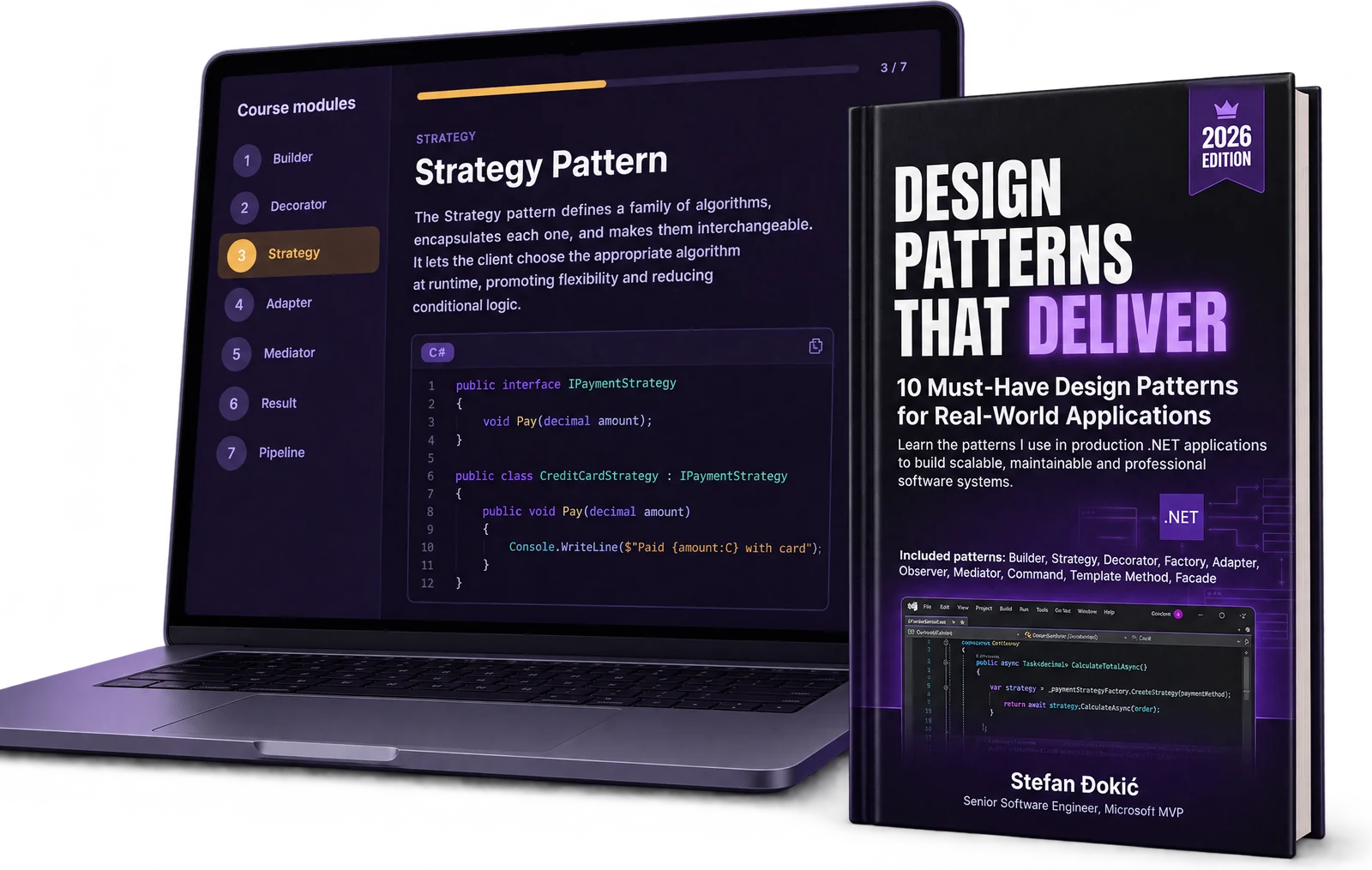
Stop guessing design patterns. Start shipping the right one.
A written course with the full ebook included. Ten production-grade C# patterns — the five everyone needs (Builder, Decorator, Strategy, Adapter, Mediator) plus five that ship real systems (Result, Pipeline, Specification, Factory, State). Each from a real problem to working code — with unit tests, trade-offs, a GitHub repo, 100 interview Q&As, and a built-in AI tutor.
Instant access Online lessons + ebook (PDF & EPUB) GitHub repo included AI tutor lifetime updates
Three ways in — pick yours
Whether you're just browsing, want to read before you buy, or already own the book — there's a door for you.
Find your pattern in seconds
Describe the problem you're stuck on. The free AI Pattern Picker recommends the right C#/.NET pattern with a tutorial for each.
Try the Pattern Picker →Read a full chapter, free
The entire Builder chapter is open in the web reader — real copyable code, diagrams, and the AI tutor on every example.
Read the Builder chapter →Ask the book anything
Sign in with your purchase and chat with Ask the Book — an AI tutor that answers strictly from the book, cited by chapter.
Open Ask the Book →"A quick and enjoyable read about the most important design patterns in C#. The examples were refreshing, and I especially liked being able to access the source code. If you're just starting or need a refresher, this book will be your design patterns companion."

You know the theory. But in the IDE, the code still looks wrong.
You've read the Gang of Four. You've watched the tutorials. You can name patterns on a whiteboard. Then a real problem lands and you freeze:
- ✕ "Should this be a Strategy or a Factory?"
- ✕ "Should I throw here, or return a Result?"
- ✕ "How does this pattern even work with DI?"
- ✕ "The example online is a Pizza class... how does that help me?"
The gap between knowing a pattern and using it in production is massive.
That's exactly what this course closes.
What changes after you read this
Before
- ✕ Copy-paste pattern examples from StackOverflow
- ✕ Can't decide which pattern fits the problem
- ✕ Overengineer simple features with the wrong abstraction
- ✕ Struggle to explain patterns in interviews
- ✕ Every tutorial uses Pizza or Animal classes
- ✕ No idea how patterns work with dependency injection
After
- ✔ Choose the right pattern in minutes
- ✔ Refactor messy code into clean, maintainable architecture
- ✔ Know exactly when to use - and when NOT to use - each one
- ✔ Speak confidently about patterns in any interview
- ✔ Have production-ready C# code with unit tests you can adapt
- ✔ Master advanced variants (Fluent/Step Builder, Scrutor, MediatR, keyed DI)
10 patterns. Real problems. Real code.
Each pattern starts with a real-world problem you'd actually hit in production - then the solution, the UML, the advanced variants, unit tests, and when NOT to use it.
The foundational five
Builder Pattern
Stop creating objects with 10-parameter constructors. From basic to Fluent, Director, Nested, FluentValidation, and a Step Builder the compiler enforces.
Decorator Pattern
Add caching, logging, or retry without touching the original class. Compose the onion in DI with Scrutor, Polly resilience, and HybridCache.
Strategy Pattern
Swap algorithms at runtime without if-else chains. Keyed DI, a factory for dynamic choice, and configuration-based selection.
Adapter Pattern
Integrate third-party APIs and legacy systems without rewriting everything. Object vs Class adapters, error translation, a cloud-agnostic storage layer.
Mediator Pattern
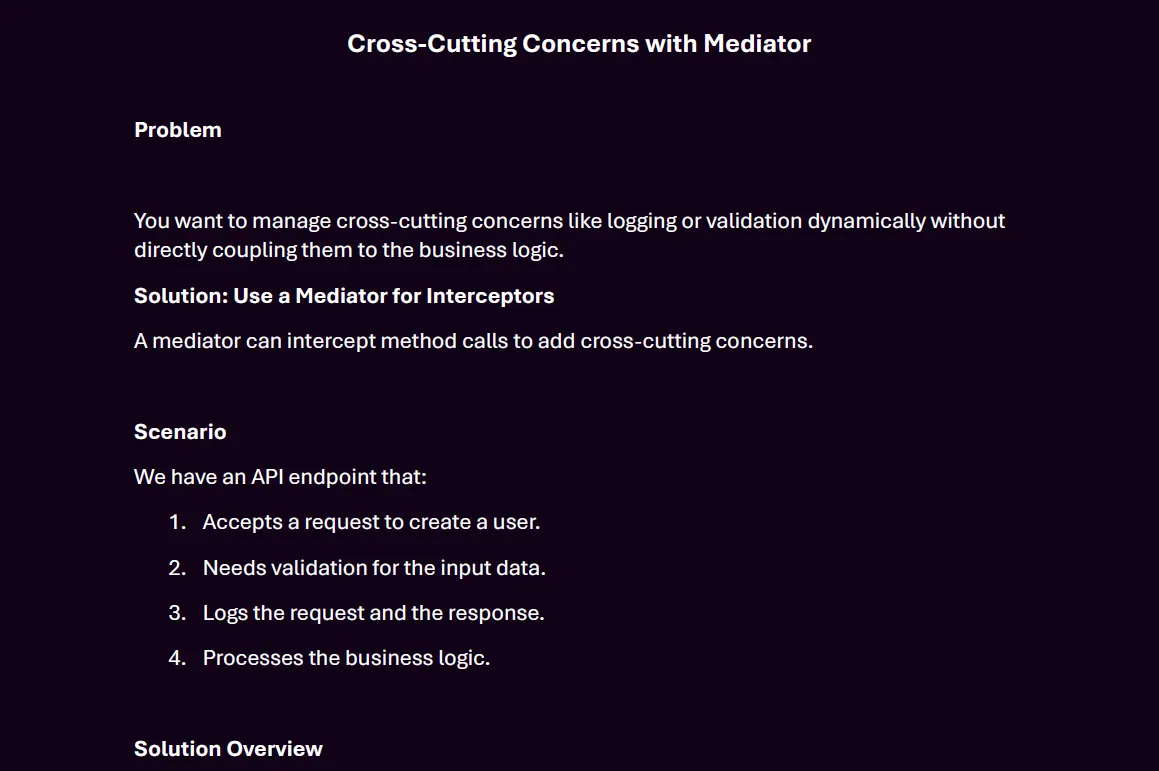
Decouple components and orchestrate communication cleanly. From a basic mediator to MediatR with validation, transaction, and logging pipeline behaviors — plus an honest take on licensing.
Five more that ship real systems
Result Pattern
Model expected failures as values, not exceptions. Railway-oriented Bind/Map/Match — including async — and clean ProblemDetails responses.
Pipeline / Chain of Responsibility
The pattern behind ASP.NET middleware. Build your own typed, async pipeline of focused handlers that each decide whether to continue.
Specification Pattern
Stop drowning the repository in query methods. Composable rules that translate to EF Core SQL — done with parameter rebinding, not the Invoke trick that throws.
Factory Patterns
Stop welding code to concrete types with new. Factory Method, Abstract Factory, and the modern .NET way — keyed DI, factory delegates, ActivatorUtilities.
State Pattern
Kill the boolean soup of IsPaid/IsShipped flags. Model a lifecycle so illegal transitions are impossible — guarded enums, class-per-state, optimistic concurrency, and Stateless for big workflows.
AI tools, not one static PDF
Most pattern books are static. This one ships with a suite of AI tools — three free for everyone, plus a tutor that knows the book. Try the free one right here.
Pattern Picker
Describe a real problem in your C#/.NET code and get the right pattern in seconds — every result links to a full tutorial, and to the book chapter where one exists.
Ask the Book
An AI tutor that answers strictly from the book — production-grade, cited by chapter. Not generic internet code. Here's what a real answer looks like:
Result. "Already shipped" is an expected outcome a user can trigger, so model it as a value and map it to a 409 Conflict — keep throw for true invariant violations. In the State chapter the guarded transition returns Result.Failure and the endpoint uses Match to pick the status code.📖 Cited: State · Result chapters[Timestamp] rowversion — and handle DbUpdateConcurrencyException. The in-memory guard stops illegal transitions; the rowversion stops concurrent ones.📖 Cited: State chapterThree free AI tools for everyone · Ask the Book unlocks when you own it.
A course, not just a PDF
Everything you need to understand, apply, and explain design patterns in real .NET projects.
The Written Course + Ebook
- ✔ Online lessons, plus the full ebook (PDF & EPUB)
- ✔ 10 patterns, problem to production
- ✔ Real scenarios + unit tests, no toy classes
- ✔ UML/Mermaid diagrams & trade-offs
- ✔ Pros, cons & when NOT to use
GitHub Repository
- ✔ 20 mini-projects, complete C#
- ✔ Clone, run, and modify instantly
- ✔ Every pattern variation implemented
- ✔ Bonus: code in 4 more languages
AI Tutor — Ask the Book
- ✔ Answers strictly from the book
- ✔ Cited by chapter, production-grade
- ✔ Plus the free Pattern Picker
- ✔ Read online with AI on every example
Interview Prep Ebook
- ✔ 100 design pattern questions
- ✔ Detailed answers with code
- ✔ Covers all major GoF patterns
- ✔ Built for senior-level interviews
EPUB + Web Reader
Read on any device, or online with copyable code and an AI tutor on every example.
Quick-Reference Guide
A pattern decision cheat sheet: when to use vs. when not to, DI integration at a glance.
100 Interview Q&As
With a working code example behind every single answer.
Written course + ebook + repo + AI tutor + interview prep + cheat sheets · all for $32.99
1250+ developers already use these patterns
Real feedback from engineers - from juniors to Microsoft MVPs - who put this course to work.
I love the simplicity of how every pattern is explained. The real-life examples are an incredible way to provide context and understand why we are choosing this pattern. By providing the writer's point of view of preferences we are able to evaluate the pros and cons, to decide which is better for our particular use case.
 Raul Fernando Aillon Salinas
The book is packed with five important design patterns in C#. Each pattern is explained step by step, with access to a GitHub repository, making it easy for everyone to grasp the material. A mini e-book featuring design pattern interview questions ensures you're well-prepared for technical interviews. Great purchase!
 Nikola Knežević
What I like is that the author starts explaining each pattern with a real use case you can have in your projects. Author takes a pragmatic way of using patterns and modifying them from the OG GOF specification, so they better fit the modern development. Each pattern usage is explained in detail with all the pros and cons. So after reading this book you will have a full understanding of how these patterns work in real applications and you will be able to recognize and understand these patterns in the existing code and popular Nuget packages. There is a GitHub repository with all the source code for this book, you can play around with. Also, every code sample in the PDF is clickable, so you can easily navigate to this code on the GitHub.
 Anton Martyniuk
Every developer should read this!
 Pavle DavitkovicSoftware developer
This book helped me understand design patterns. It showed me how to use them in real projects. I appreciate the author's work.

Built by a developer, for developers.
Hi, I'm Stefan Đokić - Microsoft MVP and Senior Software Engineer with years of experience building production .NET systems.
I built this course because I was frustrated with pattern books that use toy examples. Every pattern in this course comes from a real problem I've solved in production code - not Pizza classes, not abstract shapes.
I teach 22,000+ subscribers through my newsletter, and 116k+ followers follow my content on LinkedIn.
Everything, for less than a lunch out.
Design Patterns that Deliver
Written course + ebook + GitHub repo + AI tutor + interview prep + cheat sheets
One-time payment · lifetime access · no subscription
- ✔ The written course: online lessons for every pattern
- ✔ The full ebook in PDF + EPUB
- ✔ 10 patterns (5 foundational + 5 production)
- ✔ GitHub repo: 20 runnable mini-projects
- ✔ Ask-the-Book AI tutor, cited by chapter
- ✔ 100 interview questions & answers
- ✔ Quick-reference pattern decision guide
- ✔ Lifetime access + all future updates
Instant access · Secure checkout via Lemon Squeezy
Why developers buy this
Is this course right for you?
Probably not, if you…
- ✕ Are a complete beginner still learning C# basics
- ✕ Want a reference for all 23 GoF patterns
- ✕ Prefer abstract theory over practical code
- ✕ Are looking for language-agnostic content only
Built for developers who…
- ✔ Are .NET / C# developers (mid-level or senior)
- ✔ Know what patterns are but struggle to apply them
- ✔ Want production-ready code with tests, not textbook theory
- ✔ Are preparing for senior-level interviews
- ✔ Want cleaner, more maintainable architecture
- ✔ Lead a team and want patterns everyone can adopt
Exactly what's inside
Click any pattern to expand. Every chapter follows the same problem → solution → advanced variants → tests → when-not-to-use flow.
🧱 Builder Pattern +
🎨 Decorator Pattern +
⚡ Strategy Pattern +
🔌 Adapter Pattern +
🚀 Mediator Pattern +
🛤️ Result Pattern +
🔗 Chain of Responsibility & Pipelines +
🔎 Specification Pattern +
🏭 Factory Patterns +
🚦 State Pattern +
🎯 Bonus: Interview Prep +
🤖 Bonus: AI Tutor & Web Reader +
Frequently asked questions
Which patterns does the book cover?+
Ten production patterns in modern C#: five foundational ones - Builder, Decorator, Strategy, Adapter, Mediator - plus five that ship real systems - Result, Pipeline (Chain of Responsibility), Specification, Factory, and State. Each goes from a real problem to working code with unit tests, trade-offs, and when-not-to-use guidance.
What are the AI tools, and which are free?+
Two. The Pattern Picker is free for everyone - describe a problem and get the right C#/.NET pattern with a tutorial link. Ask the Book is an AI tutor for owners that answers strictly from the book, cited by chapter - accurate, production-grade, not generic internet code. You can try the Pattern Picker live on this page.
Are design patterns still relevant in modern .NET?+
Absolutely. MediatR (Mediator), Scrutor (Decorator), Polly (resilience), IHttpClientFactory (Factory), keyed DI, and ASP.NET middleware (Chain of Responsibility) are all pattern implementations used daily in production .NET around dependency injection, pipelines, and Clean Architecture.
How is this different from other design patterns books?+
Most pattern books explain theory with abstract examples (Pizza, Animal, Shape classes). This ebook starts every pattern with a real production problem, shows the solution in C# with unit tests and trade-offs, then explores advanced variants. You also get a GitHub repo with 20 runnable mini-projects and a built-in AI tutor.
What knowledge level do I need?+
You should be comfortable with C# and basic .NET development. The ebook is designed for intermediate to senior developers who know the language but want to level up their architecture and design skills. It's not for absolute beginners.
Do I get code I can use in my own projects?+
Yes. You get full access to a GitHub repository with 20 mini-projects - one for each pattern and each advanced variant. The code is structured, documented, and ready to clone, run, and adapt.
What formats does the ebook come in?+
You get PDF and EPUB, plus a web reader so you can read online with copyable code and the AI tutor on every example. Both light and dark modes are included.
Is there a refund policy?+
The ebook is a digital product delivered instantly. If you're not satisfied, reach out directly and we'll work it out. 1250+ developers have purchased it and the feedback has been overwhelmingly positive.
Real C# code you can apply in your next PR.
Get the Course - $32.99 →Instant download · PDF + EPUB · GitHub repo · AI tutor · 1250+ copies sold