Stefan Đokić
A quick word from me
This issue isn't sponsored - I write these deep dives in my free time and keep them free for everyone. If your company sells AI tools, dev tools, courses, or services that .NET developers would actually use, sponsoring an issue is the most direct way to reach them.
Want to reach thousands of .NET developers? Sponsor TheCodeMan →The Problem: Why Third-Party Integrations Become Messy
Integrating third-party services into your .NET application can quickly become messy.
Different APIs come with:
- different request formats
- different authentication mechanisms
- different response structures
Over time, this leads to tightly coupled code that is hard to maintain, test, and extend.
So how do you integrate external services without polluting your core business logic?
This is exactly where the Adapter Pattern shines.
In this article, you’ll learn how to use the Adapter Pattern in .NET to simplify third-party integrations, keep your architecture clean, and make your codebase easier to evolve — with real-world examples you can apply immediately.
What is the Adapter Pattern?
The Adapter Pattern is a structural design pattern that allows incompatible interfaces to work together.
It acts as a bridge between your application and an external system by converting one interface into another that your application expects.
- 👉 In simple terms: The Adapter Pattern wraps a third-party service and exposes a clean, consistent interface to your application.
Why is this important?
It allows you to:
- decouple your business logic from external systems
- easily switch providers
- improve testability
- reduce breaking changes
How the Adapter Pattern Works
The Adapter Pattern acts as a translator between two systems.
Here’s the flow:
- Create an Adapter
- Delegate to the external system
- Return standardized results
Adapter Pattern in .NET – Real-World Example
Scenario
You have a modern application using this interface:
public interface IPaymentProcessor{ void ProcessPayment(decimal amount);}
Your entire application depends on this abstraction.
However, your legacy system looks like this:
public class LegacyPaymentService{ public void MakePayment(string amount) { Console.WriteLine($"Processing payment of {amount} via legacy system."); }}
Problem
- The method signature is different
- The data type is different
- You cannot modify this legacy system
Step 1: Create the Adapter
public class PaymentAdapter(LegacyPaymentService legacyService) : IPaymentProcessor{ public void ProcessPayment(decimal amount) { string amountString = amount.ToString("F2"); legacyService.MakePayment(amountString); }}
Explanation
This adapter:
- implements your application interface (
IPaymentProcessor) - converts decimal → string
delegates the call to the legacy system
👉 Result: your app stays clean and unaware of the legacy implementation.
Step 2: Use the Adapter
internal class Program{ static void Main(string[] args) { LegacyPaymentService legacyService = new(); IPaymentProcessor paymentProcessor = new PaymentAdapter(legacyService); paymentProcessor.ProcessPayment(123.4567868m); }}
Explanation
- Your application uses only
IPaymentProcessor - The adapter handles all translation
The legacy system is fully isolated
👉 This is exactly what clean architecture looks like in practice.
Definition (Formal)
The Adapter Pattern is a structural design pattern that allows two incompatible interfaces to work together by acting as a bridge.
It converts the interface of a class into another interface that the client expects, enabling integration without modifying existing code.
Object Adapter vs Class Adapter
Object Adapter (Recommended in .NET)
Use when:
- working with third-party libraries
- you cannot modify the original class
- flexibility is required
Class Adapter
Uses inheritance.
Use when:
- inheritance is acceptable
- the adaptee is not sealed
- performance is critical
Real-World Example: Cloud Storage Integration
Imagine building a system that supports multiple cloud providers:
- Amazon S3
- Azure Blob Storage
- Google Cloud Storage
Each provider has completely different SDKs and APIs.
Without an adapter:
- 👉 your entire codebase becomes tightly coupled.
Step 1: Define a Common Interface
public interface ICloudStorage{ Task UploadFileAsync(string containerName, string fileName, Stream fileStream); Task<Stream> DownloadFileAsync(string containerName, string fileName); Task DeleteFileAsync(string containerName, string fileName);}
Explanation
This interface represents:
- your system’s contract
a stable abstraction
👉 Your app should depend only on this.
Step 2: Implement Adapter (Google Cloud Example)
public class GoogleCloudStorageAdapter : ICloudStorage{ private readonly StorageClient _storageClient; public GoogleCloudStorageAdapter(StorageClient storageClient) { _storageClient = storageClient; } public async Task UploadFileAsync(string containerName, string fileName, Stream fileStream) { await _storageClient.UploadObjectAsync(containerName, fileName, null, fileStream); } public async Task<Stream> DownloadFileAsync(string containerName, string fileName) { MemoryStream memoryStream = new(); await _storageClient.DownloadObjectAsync(containerName, fileName, memoryStream); memoryStream.Position = 0; return memoryStream; } public async Task DeleteFileAsync(string containerName, string fileName) { await _storageClient.DeleteObjectAsync(containerName, fileName); }}
Explanation
- wraps Google SDK
- translates calls into your interface
- hides implementation details
Step 3: Dependency Injection Setup
builder.Services.AddTransient<Func<string, ICloudStorage>>(sp => provider =>{ return provider switch { "Azure" => sp.GetRequiredService<AzureBlobStorageAdapter>(), "Google" => sp.GetRequiredService<GoogleCloudStorageAdapter>(), "AWS" => sp.GetRequiredService<S3StorageAdapter>(), _ => throw new ArgumentException("Unsupported cloud provider") };});
Explanation
- dynamically selects adapter
- keeps system flexible
- allows runtime switching
When Should You Use the Adapter Pattern?
Use it when:
- integrating third-party APIs
- working with legacy systems
- standardizing multiple providers
- switching implementations
When NOT to Use It
Avoid when:
- interfaces are already compatible
- transformation is trivial
- performance is extremely critical
- abstraction adds unnecessary complexity
For more design patterns in .NET, check out the Strategy Pattern and the Chain of Responsibility Pattern.
Wrapping Up
The Adapter Pattern is one of the most practical patterns in real-world .NET applications.
It helps you:
- simplify integrations
- reduce coupling
- improve flexibility
Instead of letting external services dictate your architecture, you take control.
- 👉 If you're working with APIs, cloud providers, or legacy systems — this pattern is essential.
FAQ
What is the Adapter Pattern in .NET?
The Adapter Pattern in .NET allows incompatible interfaces to work together by wrapping external services and exposing a consistent interface.
When should I use the Adapter Pattern?
Use it when integrating third-party APIs, working with legacy systems, or decoupling your application from external dependencies.
Adapter vs Decorator Pattern?
- Adapter → changes interface
- Decorator → adds behavior
Resources
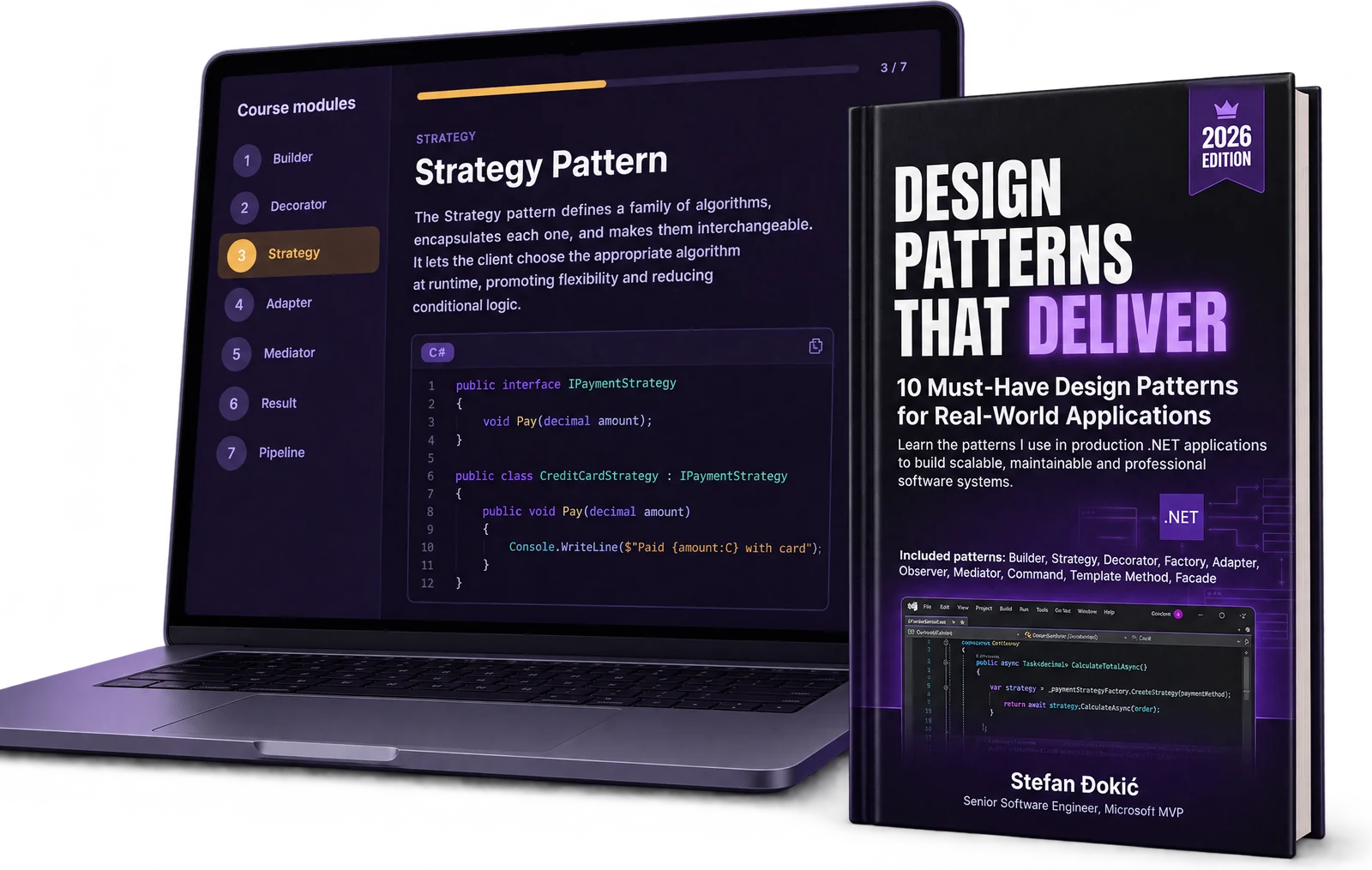
This is a complete chapter from my Design Patterns that Deliver ebook.
Use code: THECODEMAN for 45% discount.
The complete code can be found in the TheCodeMan Community.
That's all from me today.
P.S. Follow me on YouTube.