Stefan Đokić
A quick word from me
This issue isn't sponsored - I write these deep dives in my free time and keep them free for everyone. If your company sells AI tools, dev tools, courses, or services that .NET developers would actually use, sponsoring an issue is the most direct way to reach them.
Want to reach thousands of .NET developers? Sponsor TheCodeMan →
Watch Builder Pattern on YouTube
The Constructor That Keeps Growing
You started with a simple EmailMessage class. Four parameters: to, subject, body, from.
Then someone needed CC. Then BCC. Then attachments. Then priority. Then reply-to. Then a flag for HTML vs plain text. Then custom headers. Then read receipts.
var email = new EmailMessage( "user@example.com", // to "Welcome!", // subject "<h1>Hello</h1>", // body "noreply@app.com", // from null, // cc null, // bcc new List<Attachment>(), // attachments Priority.Normal, // priority null, // replyTo true, // isHtml null, // customHeaders false // readReceipt);
Twelve parameters. Half of them are null. Nobody remembers which position is which without hovering over the constructor. And every time you add a new parameter, every call site breaks.
This is the telescoping constructor problem. And it gets worse as the object gets more complex.
The Problem: Complex Object Construction
The real pain isn't just the ugly constructor. It's the combinations.
Some emails have attachments but no CC. Some need read receipts with high priority. Some are plain text with custom headers. Creating a constructor overload for every valid combination is impossible.
So developers do one of two things: they create a monster constructor with 15 optional parameters, or they use object initializers with mutable properties:
var email = new EmailMessage{ To = "user@example.com", Subject = "Welcome!", Body = "<h1>Hello</h1>", IsHtml = true // Easy to forget required fields // Object is in an invalid state until all fields are set};
This looks cleaner but introduces a new problem: the object can exist in an invalid state. What if someone forgets to set To? Or sets Body but not Subject? You only find out at runtime.
Enter the Builder Pattern
The Builder pattern separates the construction of a complex object from its representation. You build the object step by step, and the builder ensures you get a valid, complete object at the end.
Building It in .NET
Define the product and a fluent builder:
public class EmailMessage{ public string To { get; } public string From { get; } public string Subject { get; } public string Body { get; } public bool IsHtml { get; } public List<string> Cc { get; } public List<string> Bcc { get; } public List<Attachment> Attachments { get; } public Priority Priority { get; } public string? ReplyTo { get; } public Dictionary<string, string> CustomHeaders { get; } // Only the builder can create this internal EmailMessage(EmailMessageBuilder builder) { To = builder.To; From = builder.From; Subject = builder.Subject; Body = builder.Body; IsHtml = builder.IsHtml; Cc = builder.Cc; Bcc = builder.Bcc; Attachments = builder.Attachments; Priority = builder.Priority; ReplyTo = builder.ReplyTo; CustomHeaders = builder.CustomHeaders; }}
Now the builder with a fluent API:
public class EmailMessageBuilder{ // Required fields internal string To { get; private set; } = string.Empty; internal string From { get; private set; } = string.Empty; internal string Subject { get; private set; } = string.Empty; internal string Body { get; private set; } = string.Empty; // Optional fields with defaults internal bool IsHtml { get; private set; } = false; internal List<string> Cc { get; private set; } = new(); internal List<string> Bcc { get; private set; } = new(); internal List<Attachment> Attachments { get; private set; } = new(); internal Priority Priority { get; private set; } = Priority.Normal; internal string? ReplyTo { get; private set; } internal Dictionary<string, string> CustomHeaders { get; private set; } = new(); public EmailMessageBuilder SetTo(string to) { To = to; return this; } public EmailMessageBuilder SetFrom(string from) { From = from; return this; } public EmailMessageBuilder SetSubject(string subject) { Subject = subject; return this; } public EmailMessageBuilder SetBody(string body, bool isHtml = false) { Body = body; IsHtml = isHtml; return this; } public EmailMessageBuilder AddCc(string cc) { Cc.Add(cc); return this; } public EmailMessageBuilder AddBcc(string bcc) { Bcc.Add(bcc); return this; } public EmailMessageBuilder AddAttachment(Attachment attachment) { Attachments.Add(attachment); return this; } public EmailMessageBuilder SetPriority(Priority priority) { Priority = priority; return this; } public EmailMessageBuilder SetReplyTo(string replyTo) { ReplyTo = replyTo; return this; } public EmailMessageBuilder AddHeader(string key, string value) { CustomHeaders[key] = value; return this; } public EmailMessage Build() { // Validate required fields before building if (string.IsNullOrWhiteSpace(To)) throw new InvalidOperationException("Recipient (To) is required."); if (string.IsNullOrWhiteSpace(From)) throw new InvalidOperationException("Sender (From) is required."); if (string.IsNullOrWhiteSpace(Subject)) throw new InvalidOperationException("Subject is required."); return new EmailMessage(this); }}
Now constructing an email is readable and safe:
var email = new EmailMessageBuilder() .SetTo("user@example.com") .SetFrom("noreply@app.com") .SetSubject("Your order has shipped") .SetBody("<h1>Order #1234 is on the way</h1>", isHtml: true) .SetPriority(Priority.High) .AddAttachment(invoicePdf) .AddHeader("X-Campaign-Id", "spring-sale-2026") .Build();
Each step is self-documenting. The Build() method validates everything before creating the object. You can't end up with an email missing a recipient.
Why This Is Better
No invalid objects. Validation happens in Build(). The object either exists in a valid state or throws during construction.
Self-documenting code. SetPriority(Priority.High) is infinitely more readable than a positional parameter buried in position 8.
Optional fields are truly optional. You only call the methods you need. No passing null for fields you don't care about.
Immutable products. The EmailMessage uses get-only properties. Once built, it can't be modified.
Advanced Usage: Director Pattern for Presets
When you find yourself building the same configurations repeatedly, extract a Director:
public class EmailDirector{ public EmailMessageBuilder WelcomeEmail(string to) { return new EmailMessageBuilder() .SetTo(to) .SetFrom("noreply@app.com") .SetSubject("Welcome to our platform!") .SetBody(WelcomeTemplate.Render(), isHtml: true) .SetPriority(Priority.Normal) .AddHeader("X-Email-Type", "welcome"); } public EmailMessageBuilder OrderConfirmation(string to, Order order) { return new EmailMessageBuilder() .SetTo(to) .SetFrom("orders@app.com") .SetSubject($"Order #{order.Id} confirmed") .SetBody(OrderTemplate.Render(order), isHtml: true) .SetPriority(Priority.High) .AddAttachment(InvoiceGenerator.Create(order)); }}
Callers can still customize after the director sets up the base:
var email = director .OrderConfirmation("customer@example.com", order) .AddCc("manager@company.com") // customize further .Build();
Advanced Usage: Building Configuration Objects
The Builder pattern works great for complex configuration in DI setups:
public class RetryPolicyBuilder{ private int _maxRetries = 3; private TimeSpan _delay = TimeSpan.FromSeconds(1); private Func<Exception, bool> _shouldRetry = _ => true; private Action<Exception, int>? _onRetry; public RetryPolicyBuilder MaxRetries(int retries) { _maxRetries = retries; return this; } public RetryPolicyBuilder WithDelay(TimeSpan delay) { _delay = delay; return this; } public RetryPolicyBuilder RetryWhen(Func<Exception, bool> predicate) { _shouldRetry = predicate; return this; } public RetryPolicyBuilder OnRetry(Action<Exception, int> callback) { _onRetry = callback; return this; } public RetryPolicy Build() => new(_maxRetries, _delay, _shouldRetry, _onRetry);} // Usage in startupbuilder.Services.AddSingleton( new RetryPolicyBuilder() .MaxRetries(5) .WithDelay(TimeSpan.FromSeconds(2)) .RetryWhen(ex => ex is HttpRequestException) .OnRetry((ex, attempt) => Log.Warning("Retry {Attempt}: {Error}", attempt, ex.Message)) .Build());
When NOT to Use It
Simple objects with few fields. If your constructor has 3-4 parameters and no optional ones, a builder adds ceremony for no benefit.
When the object never changes. If the construction is simple and stable, a constructor or static factory method is simpler.
When immutability isn't needed. If the object is a plain DTO that gets modified after creation anyway, a builder's validation guarantees lose their value.
Key Takeaways
- The Builder pattern eliminates telescoping constructors and invalid object states
- Fluent APIs make construction code self-documenting
Build()is your validation gate - the object is either valid or doesn't exist- Directors encapsulate common construction recipes
- Don't use it for simple objects with few fields - it's overhead without value
FAQ
What is the Builder pattern in simple terms?
The Builder pattern constructs complex objects step by step. Instead of calling a constructor with many parameters, you call descriptive methods to set each part, then call Build() to create the final, validated object.
When should I use the Builder pattern?
Use it when objects have many optional parameters, when the construction process requires validation, or when you need to create different representations of the same type. It's especially useful for configuration objects and message builders.
Is the Builder pattern overkill?
For objects with 3-4 simple fields and no optional parameters, yes. The Builder adds value when constructors get complex, when objects need to be immutable, or when you have many valid configurations.
What are alternatives to the Builder pattern?
For simple cases, constructor overloads or static factory methods work fine. C# records with with expressions offer a lightweight alternative for immutable objects. Object initializers work when validation at construction time isn't critical.
Wrapping Up
The Builder pattern solves a very human problem: constructors that nobody can read. When your objects get complex, the fluent API makes construction code that reads like documentation.
Start using it when your constructors hit 5+ parameters or when you find yourself passing null for optional fields. Your future self will thank you when reading the code six months later.
That's all from me today.
P.S. Follow me on YouTube.
If you made it this far, you're clearly serious about writing better .NET code. Here's a 20% discount code: DEEP20 for Design Patterns that Deliver. Consider it a thank-you for actually reading the whole thing.
Here are 2 ebooks I have about design patterns:
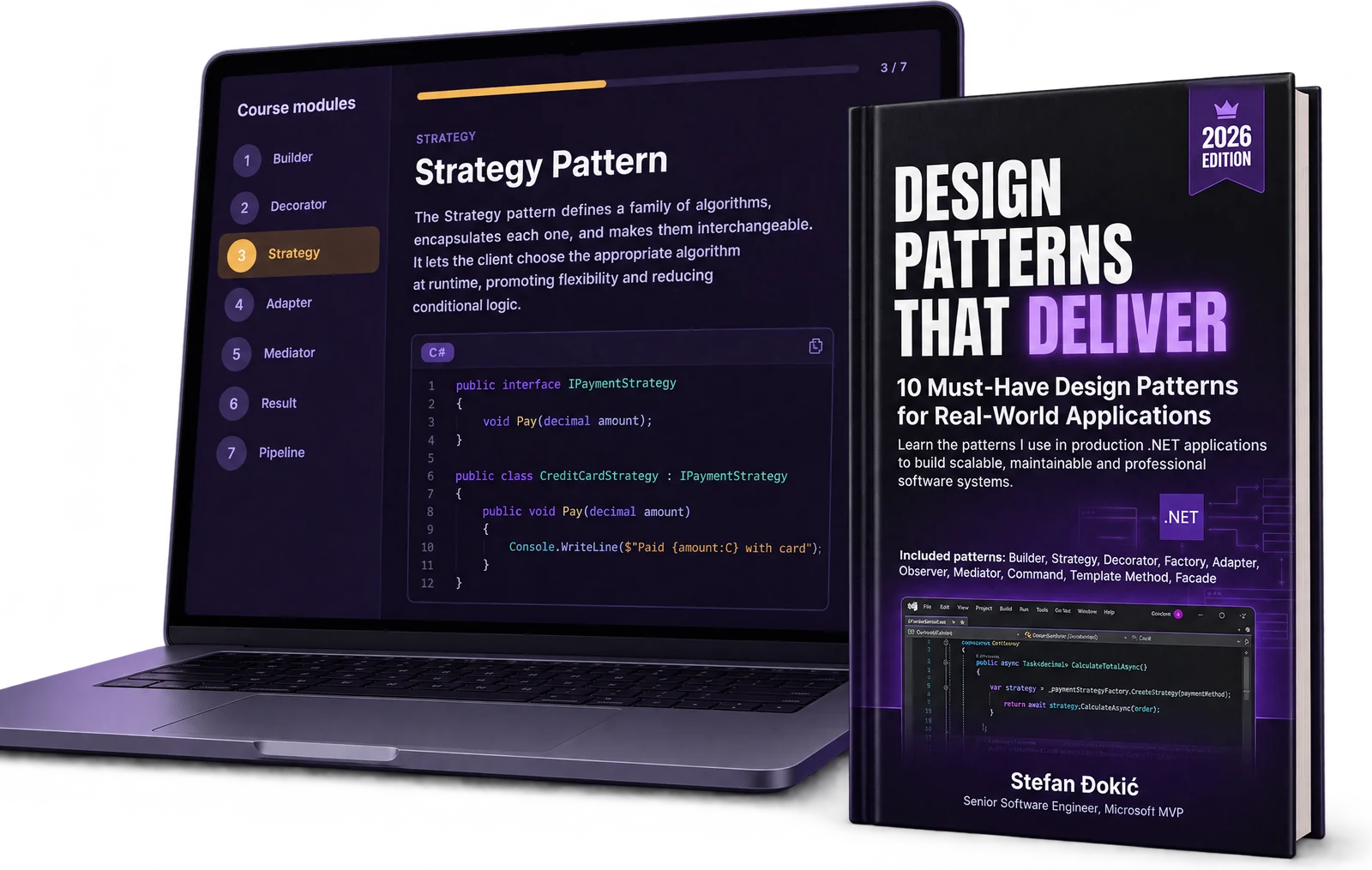
Design Patterns that Deliver — 5 essential patterns (Builder, Decorator, Strategy, Adapter, Mediator) with production-ready C# code and real-world examples. Or try a free chapter on the Builder Pattern first.
Design Patterns Simplified — A beginner-friendly guide to understanding design patterns without the academic fluff.